I’m back. I had hoped to post a few follow-up reflections on Theo of Golden soon after my review of the book, but life in all its glory gave me gifts. I celebrated the birth of my youngest grandson and the 13th birthday of my oldest. I vacationed in my beloved Low Country of South Carolina and along the shores of Lake St. Claire in Michigan, and finished my travels by attending a bridal luncheon in honor of my niece in Franklin, Tennessee. A good time was had by all, and I came away grateful for the grace and mercy shown by God and others. I plan to post more reflections on Theo this coming weekend. In the meantime, please enjoy these photos of my time in the Low Country. As always, click on the photo for a larger view.
Tuesday, August 19, 2025
Monday, July 07, 2025
When a Poem Becomes Prose
And with sighs soaring, soaring síghs deliver
Them; beauty-in-the-ghost, deliver it, early now, long before death
Give beauty back, beauty, beauty, beauty, back to God, beauty's self and beauty's
giver.
See; not a hair is, not an eyelash, not the least lash lost; every hair
Is, hair of the head, numbered.
When the thing we freely fórfeit is kept with fonder a care,
Fonder a care kept than we could have kept it, kept
Far with fonder a care (and we, we should have lost it) finer, fonder
A care kept.—Where kept? Do but tell us where kept, where.—
Yonder.—What high as that! We follow, now we follow.—Yonder, yes yonder, yonder, Yonder.
Gerald Manley Hopkins, “The Leaden Echo and The Golden Echo”
Allen
Levi is an alchemist[1] in
the vein of Gerald Manley Hopkins. His debut novel, Theo of Golden, is a
Hopkins’ poem become prose; their philosopher’s stone, a vision of heaven.[2]
Gerald
Manley Hopkins works as an alchemist in his poetry, and in particular, in the
poem “The Leaden Echo and The Golden Echo.” In the first of this
two-part poem, The Leaden Echo, Hopkins shows our faltering attempts that
transform natural sorrow over beauty’s decay and loss into despair when we try
to find a key to hoard, to “keep it, beauty, beauty, beauty…from vanishing
away.” He does not leave us in in
inevitable despair. His second part, “The Golden Echo”, shows there is “such a
key, …such a place” for beauty where inevitable sorrow’s only end is not
despair, but hope. It is found when we “Give beauty back, beauty, beauty,
beauty, back to God, beauty’s self and beauty’s / giver”. God keeps it “Yonder,”
in His heaven, with “Fonder a care kept than we could have kept it”, never
hoarding it and beckoning us to “…follow, now we follow” to live wisely and generously
in the beauty He gives and keeps.
Allen Levi works his alchemy through his title character Theo, and Theo’s work and vision of heaven, as he lives for a year in the small Southern college town of Golden. We meet him greeting an early morning sunrise in the newborn
days of a Southern spring after escaping New York City’s leaden wintery
weather. After an early morning spent strolling down Broadway, lingering at
whatever captures his attention, he wanders into The Chalice, a local coffee
shop, where “the aroma of caffeine” is inviting and portraits of patrons adorn
the walls. It is in these portraits that he discovers another part of his
purpose, “his life’s work” in Golden.
In each skillfully wrought
portrait, Theo sees with long-trained eyes and hard-earned sadness, a glimpse
of leaden sorrow, “like
a weariness or unmet longing or a disappointment”, “the universal affliction”.
He also sees, with the generosity grown by heavenly vision, a glimmer of their
beauty, their “chalice of gold.” He decides to unite patrons and portraits, and
when he does, he also gives back to them their beauty, a particular “potential
of saintliness” he sees in their portraits. Reminding them, when they protest
that saintliness, that they are raw materials, lead becoming gold and “great
love can grow out of sadness if it is well-tended.” Theo’s patient
attentiveness to each and to their stories, which they entrust to him, allows
friendships and their own beauty to grow and to be shared.
This
is not your typical Christian fiction.[3]
Allen Levi does a masterful job as he “steal[s] past those watchful dragons.”[4] The sadness born of evil and brokenness is
portrayed in both subtle and aggressive ways, as it is in the world. Levi’s
portrayals of these, whether in the mental illness of Ellen, the ghost of
Vietnam that haunts Tony, or the abuse of the vulnerable Claris, and other
stories, are never used gratuitously to make a moralistic point. His
characters suffer from evil and brokenness at the hands of others, the
consequences of their own faulty decisions, the fallen world, and sheer wanton
evil. Theo's reactions to evil and brokenness are as varied as the forms they
take. He meets their stories of sorrow and failure with patient attentiveness,
that “rarest
and purest form of generosity”[5], and with empathy and compassion. But when
wanton evil presents itself, it is met with a resounding “Stop!” and, in doing
so, reminds us such a response will be necessary, godly, and costly.
Levi,
like Hopkins, does not leave his characters, or his readers, without hope in
the sorrow that loss brings. As you read of Theo’s patient attentiveness and generosity
that reflects his “clear conviction of [heaven’s] reality and beauty”, you are
also given glimpses of the patient attentiveness and generosity of other
characters in ways that are small, mundane, sometimes motivated by “bad mercy.”
You see the characters, settings, and stories participating in and embodying
the Good as they were created to and using their sorrow as a “seedbed of
creativity.”[6]
They act on the belief, conscious or not, that the beauty they can
offer, and not hoard or fear its loss because it is kept safe, as Hopkins shows
us, is part of “May your will be done on
Earth as it is in Heaven,” can mean. They
can act even if, in the midst of their doubting, they ask the question that Tony
does, “Heaven?, My god, you don’t believe in that sort of thing, do you?” This
question, while asked with incredulity and in good-natured ribbing, offers us
the opportunity to ask it of ourselves, recognizing the sorrows from loss that
often prompt the question, and patiently attend to the answers we find.
With
names like Theo, Ponder House, The Chalice, and Golden, I initially wondered if
the book would be an over-the-top allegory. It proved to be something better,
something akin to a philosopher’s stone, as it acts on “the fertility of [your]
imagination.” Allen’s descriptive, lyrical prose and attention to both mundane
and sublime beauties encourage us to experience the story as it unfolds. Paying
careful attention will reward you with passages that draw you in when
describing natural beauty, the delightful quirks and strengths of characters
and places, and with allusions to Augustine, C. S. Lewis, and others. The
stories are parables in their own right, and I look forward to his next book, “Ellen.”
[1]
One of alchemy’s practices was to turn a base material, such as lead, into a
noble one, such as gold. It was long considered unattainable until this.
[2] I have no inkling if Allen Levi knew of or intended to turn this poem into prose, but their similarity in vision is remarkable. Consider them as you would a pairing of fine wine and an elegant meal, one enhancing the other.
[3] I've stayed away from all reviews of the book and interviews with the author, save for one small snippet in which he explains he did not set out to write a particular kind of Christian fiction with certain buzzwords and predictable plots. His short mission statement is simply “Use creative gifts to provoke Godward thought.” In this writer’s opinion, he succeeds here.
[4]
“Sometimes Fairy Stories May Say Best What’s to Be
Said” C. S. Lewis
[5]
Simone Weil in Gravity and Grace
[6]
Andy Crouch
https://www.youtube.com/watch?v=URZBI7ycJa0
Monday, June 02, 2025
Theo of Golden
Friday, November 29, 2024
Advent 2024
The people who walked in darkness have seen a great light;
those who dwelt in a land of deep darkness, on them has light shone.
Isaiah 9:2
It's time to prepare for Advent. I've gathered a few resources to share with you, which I hope and pray (really, I pray) will prepare you to rejoice at Christmas that a great Light has come into our world.
I've just finished meeting with a reading group at my church to discuss the challenges of complicated relationships. The Christmas holidays can add to those challenges, especially in our society. For some, the grief and longing in our souls over difficult relationships can feel heightened by the joyous festivity of the season. We all react differently to the added stress, not only the challenge of the relationship, but also we may feel the need to bury our hurt in an effort not to affect others with our grief. Some of us will continue with our traditions, some will ignore the season altogether, and others will choose to downplay the season. Any of these may be the wisest choice available to us; I’ve made use of them all at one time or another. However, another option is rooted in something other than our coping reactions. One rooted in a historical practice of the Church, the observance of Advent, which can offer us a way to live in our grief and sadness as it points us to hope in Christ's incarnation and his return.
Hannah Anderson explains Advent in this manner as a way "to prepare your heart for Christmas by considering why Jesus came to earth in the first place and why we so desperately long for his return. I want to offer you hope--not by ignoring the brokenness but by looking it squarely in the face, knowing that your Redeemer has and will come." 1
Simply said Advent is a time not to dismiss sorrows but to acknowledge our own sorrows, the sorrows of this world, and the needs that come from living in those sorrows. Sorrows can be many: political unrest domestically and abroad, financial worries, and ill health, whether physical, mental, or emotional, and yes, especially, broken and difficult relationships. After all, Christ came to reconcile us to our Heavenly Father, to rescue and redeem us from our estrangement from Him and all that entailed. He came to renew our relationship with God and let us know He is with us, Immanuel, in our sorrows and even now is working to set them to right.
While I recommend the resources below to help you reflect on our need for reconciliation with Christ and why we can grieve during Advent, I encourage you to put something into practice. Grief and sorrow affect our bodies, minds, and souls in ways recognized many years ago but downplayed until recently. Our minds, bodies, and souls are not separate entities; they are integrated in ways we don't fully understand, and one affects the others. One way of finding comfort for body, mind, and soul is to find beauty in your day. Beauty affects our entire being in ways we don't fully understand, but we experience it as a gift, often received without effort, such as a sunset that causes you to catch your breath or a baby's smile of delight. The reception of beauty can remind us of the grace we receive in our salvation, freely given to be freely received. Sarah Clarkson, explains the role beauty can play explains this well in her book This Beautiful Truth: How God's Goodness Breaks into Our Darkness. She tells her story of suffering from mental illness and how God used beauty in her life to remind her of Him and His care. She believes that beauty is a theodicy that we, as humans, can best understand. She encourages us to " 'taste and see' goodness of what he has made and what he continues to create amid our darkness." 2 Simple things can add beauty and comfort to your life when it seems fleeting. You need beauty, and the comfort and hope it gives, even if you don't realize it. Below, I've given examples of simple beauties that encourage me in dark hours; yours are probably different. If you are unsure how to find those beauties, think of things that brought you wonder as a child.
One very simple thing I do is light a candle or two in the early pre-dawn morning or late night hours. The soft glow in the dark helps soften the weariness I sometimes feel in my soul. It reminds me that I have a great light in the darkness.
Feeding and watching birds enjoy the food I offer them encourages me to see I have something to offer, even amid the pain, and to remember that God watches over us all. You can purchase a single suet feeder and suet cake to hang outside a window to get started. This has the advantage of not being expensive (under $5) and offering the birds needed fat for their diet, especially during these colder months.
Short walks in a park or local trail help me to "get out of my head" and focus on the natural creation as the gift it is. Elissa Yukiko Weichbrodt, an art professor at Covenant College in Lookout Mountain, Georgia, goes on contemplative color walks. She chooses a different color each time she walks and looks for it. While looking for color may or may not work depending on your location during the winter months, you can adapt this to look for anything in nature that you enjoy. Most neighborhoods have parks and trails nearby. A walk in your neighborhood will offer much as you pay attention.
I take photos with my cameras, especially my phone camera, of the beauty I see as a way to see, record, and remember the beauty I encounter. It might be something as simple as the steam rising from my mug of tea or the way the morning or evening light shines on the corner of a room.
I also keep a list of those things that don’t lend themselves to capturing with a camera. The delicious taste of the Black Walnut cake I made from my grandmother’s recipe, the quiet of sitting in a dark room with only the lights on the tree, and memories of happier times.
All these suggestions and more are meant to put you into a place where you can receive the good gifts God gives if we take the time to notice. This can be difficult to do alone. If so, ask a friend to walk with you both metaphorically and literally during this time. If you know someone whose sorrows make the holidays hard, commit to spending them, along with offering your prayers for them. One of my most precious memories is the thoughtful messages from friends on Christmas day.
As I promised, here are a few books, videos, websites, and more that may encourage you during Advent and Christmas.
First up, an Advent workshop by Hannah Anderson with the Equipping Group. Take an hour and a half to listen to this engaging presentation, and come prepared to take a few notes or jot down something that stirs an idea in you. If you are like me and didn't grow up with Advent as part of your life, Hannah walks us through how to incorporate Advent into your current traditions. Even if Advent is not something you are interested in, her thoughts on how different religious communities approach faith formation are well worth your time. You can find it at this link: Re-Engaging the Heart of Advent
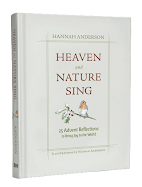
As mentioned in the video, Hannah has written a book for Advent, Heaven and Nature Sing: 25 Advent Reflections to Bring Joy to the World. This follows on the heels of her book and in the same vein as Turning of Days: Lessons from Nature, Season, and Spirit. When I used the book last year for Advent, I found 25 days of devotionals that point to the Promised Son by exploring the natural world of swaddling clothes and aging, valleys and mountains, and evergreens and pigeons. This is a beautiful hardbound book, from the textured cover to the lovingly illustrated pages. You can see more about the book at Hannah's website: Hannah Anderson. While at the site, check out the "Shop" tab in the upper right corner, where you can purchase notecards of some illustrations in the book. You can find her on Twitter and Instagram.
The following resource is one that I have appreciated for several years now: Biola's Advent Project. This Advent resource stands out with its daily selections of scripture, devotional, and artwork, including poetry, visual art, and music. You can view it on the web each day or sign up to have a link sent to you. If you want samples of what is offered, look at Advent 2021. Be sure to look at the "About" tab at the bottom for interesting information about the artwork included.
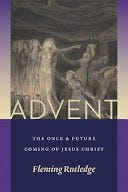
Advent: The Once and Future Coming Of Jesus Christ is a collection of sermons and articles by Rev. Fleming Rutledge that focus on the reality of Christ coming to us in our darkness, bringing light that will not be quenched. This is an extensive volume; thankfully, she has suggestions for how to use the book. I will read many of the Pre-Advent works and then choose one or two from each chapter corresponding to a particular Sunday of Advent. You can find more from Rev. Rutledge on her website.
For those who would like a free option for your phone, this app from Christian House Publishing produces audio of the Daily Prayer for the morning, evening, and night all year round. If you prefer not to use an app, scroll down to the linked website and find the daily prayer.
One that I will be adding this year that is in line with the concept of receiving beauty is the Visual Commentary on Scripture's Creation: Advent Calendar 2024. From their site, "...we will share a daily link to a creation-related artwork and its associated commentary. An audio option will be available, allowing you to enjoy listening to the commentary while exploring the high-resolution image." These devotionals are available here, and you can sign up to have them delivered to your email.
I'll have more in the coming days. My prayer and hope for you is that you will have eyes to see, ears to hear, and a heart to believe that in those dark moments, you will remember you have hope. Hope that is Christ. There is nothing more sure than Him.
Saturday, September 07, 2024
Meditations While Weeding
This spring and summer have been one for the book when elderly parents became seriously ill, with one passing and one recovering slowly. It became a season that required a lot of time away from home and grew a weariness from the stress and grief of life naturally embedded in such seasons. It all gave way to the garden surrounding my home producing weeds, not beauty and peace. When some weeds became tall enough to block the view from the patio, I finally pulled on gloves and began weeding.
Weeds are just part of this life.
Some weeds require you to pull them one at a time to protect the roots of the surrounding plants.
Other weeds can be pulled out by the handfuls.
Some weeds are actually invasive bushes that need a pick axe to remove them.
Weeds are just part of this life.
Fifteen minutes a day would have kept the weeds from taking over the garden.
Some weeds are prairie grasses that look great in my pasture but not in the garden surrounding my home.
While weeding and sweating, enjoy the sunny autumn-blue sky, gentle breeze, hummingbird buzzing around your head, and red-shouldered hawk calling from a distance. You need to look for the joy in the journey.
Look out for the turtle and black snake, who you know live in the garden. On second thought, look out for all the snakes.
Don’t waste your good well-water on weeds.
Enjoy washing your sweaty face with well-water from the garden hose. Then, take a good, long drink from the garden hose. Sorry, suburban and urban dwellers, but water from the well is colder and tastes better. I don’t make the rules.
Weeds are just part of this life
The more empty spaces you have, the more weeds can gain a foothold.
A necessary corollary is planting more herbs, lavender, butterfly, and blueberry bushes—any good thing to cover those empty spaces.
Enjoy both a job well done and a shower when you finish.
Sit on the patio in the evening and read for a bit as you enjoy the view.
Life is not all about weeds.
Let the reader understand.
Friday, August 30, 2024
Dorothy and Jack: The Transforming Friendship of Dorothy L. Sayers and C. S. Lewis by Gina DalfonzoI found this book very well done. Gina Dalfonzo did an excellent job presenting Dorothy Sayers and C. S. Lewis as individuals and friends. By looking at their friendship, she brings out more of their character, giving a deeper insight into both of them. I listened to the audiobook and hope to return to read the print edition in the future. I recommend this to anyone who wants to know more about Sayers, Lewis, and friendship.
View all my reviews
Sunday, June 25, 2023
Slowing down-Leucistic Female Mallard
We are home from back-to-back trips, three weeks in England and Ireland, and a week with my older daughter and her family. This leucistic female Mallard was quite at home in the fountain at The Oxford Botanic Garden and Arboretum. Originally taken for a record of birds I saw on my trip, I came to appreciate it more as I looked at the colors and textures. Aspects I hadn't noticed when I initially framed and took the shot, and probably wouldn't have noticed, but for taking time to slow down and look more closely. It's one of the gifts I'm finding in photography and would find in other parts of my life if I did so.
Tuesday, May 16, 2023
Saturday, January 07, 2023
National Bird Day - A Day or Two Late
I missed National Bird Day, but the next day made up for it. I've been trying to get a good shot of this fella for a while and finally! #nationalbirdday #pileatedwoodpecker
| click for a larger image |
Tuesday, January 03, 2023
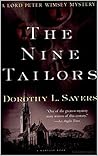
The Nine Tailors by Dorothy L. Sayers
The Nine Tailors by Dorothy L. SayersMy rating: 5 of 5 stars
Update: 1/3/2 It was even better reading it a second time. Most good books are. I rarely give 5 stars (to authors whose works I review; it's nothing personal), but this one deserves it. Few books I read have to capacity to shape me as I read them. This one does.
Previous review: (slightly updated)
"So I think I'd better go, said Wimsey. "I rather wish I hadn't come buttin' into this. Some things may be better left alone, don't you think? My sympathies are all in the wrong place and I don't like it. I know all about not doing evil that good may come. It's doin' good that evil may come that is so embarrassin'."
"My dear boy," said the Rector, "it does not do for us to take too much thought for the morrow. It is better to follow the truth and leave the results in the hand of God. He can forsee where we cannot, because He knows all the facts."
With this quote, I understood why Sayers designed such an "easy" mystery and placed it on my re-read list.
Friday, December 23, 2022
Siberia Vortex gifts
The photo to the right is a female house finch. While not as colorful as her mate, taking a closer look you will see her feathers are just as beautiful.
The photos to the right and below show the two types of nuthatches I see frequently, the white-breasted nuthatch and the red-breasted nuthatch. Bird guides tell me the white-breasted is uncommon for my area, but I see them often.